and, or, xor, test, and not; the rotates are ror, rol, rcr, and rcl; the shift instructions are shl/sal, shr, and sar. The 80386 and later processors provide an even richer set of operations. These are bt, bts, btr, btc, bsf, bsr, shld, shrd, and the conditional set instructions (setcc).The 80x86 logical instructions operate on a bit-by-bit basis. Both eight, sixteen, and thirty-two bit versions of each instruction exist. The and, not, or, and xor instructions do the following:
        and     dest, source            ;dest := dest and source
        or      dest, source            ;dest := dest or source
        xor     dest, source            ;dest := dest xor source
        not     dest                    ;dest := not dest

The specific variations are

        and     reg, reg
        and     mem, reg
        and     reg, mem
        and     reg, immediate data
        and     mem, immediate data
        and     eax/ax/al, immediate data

        or uses the same formats as AND
        xor uses the same formats as AND

        not     register
        not     mem
Except not, these instructions affect the flags as follows:
The not instruction does not affect any flags.
Testing the zero flag after these instructions is particularly useful. The and instruction sets the zero flag if the two operands do not have any ones in corresponding bit positions (since this would produce a zero result); for example, if the source operand contained a single one bit, then the zero flag will be set if the corresponding destination bit is zero, it will be one otherwise. The or instruction will only set the zero flag if both operands contain zero. The xor instruction will set the zero flag only if both operands are equal. Notice that the xor operation will produce a zero result if and only if the two operands are equal. Many programmers commonly use this fact to clear a sixteen bit register to zero since an instruction of the form
xor reg16, reg16
is shorter than the comparable mov reg,0 instruction.
Like the addition and subtraction instructions, the and, or, and xor instructions provide special forms involving the accumulator register and immediate data. These forms are shorter and sometimes faster than the general "register, immediate" forms. Although one does not normally think of operating on signed data with these instructions, the 80x86 does provide a special form of the "reg/mem, immediate" instructions that sign extend a value in the range -128..+127 to sixteen or thirty-two bits, as necessary.
The instruction's operands must all be the same size. On pre-80386 processors they can be eight or sixteen bits. On 80386 and later processors, they may be 32 bits long as well. These instructions compute the obvious bitwise logical operation on their operands, see Chapter One for details on these operations.
You can use the and instruction to set selected bits to zero in the destination operand. This is known as masking out data; see for more details. Likewise, you can use the or instruction to force certain bits to one in the destination operand; see Chapter Nine for the details. You can use these instructions, along with the shift and rotate instructions described next, to pack and unpack data.
The 80x86 supports three different shift instructions (shl and sal are the same instruction): shl (shift left), sal (shift arithmetic left), shr (shift right), and sar (shift arithmetic right). The 80386 and later processors provide two additional shifts: shld and shrd.
The shift instructions move bits around in a register or memory location. The general format for a shift instruction is
        shl     dest, count
        sal     dest, count
        shr     dest, count
        sar     dest, count
Dest is the value to shift and count specifies the number of bit positions to shift. For example, the shl instruction shifts the bits in the destination operand to the left the number of bit positions specified by the count operand. The shld and shrd instructions use the format:
        shld    dest, source, count
        shrd    dest, source, count
The specific forms for these instructions are
        shl     reg, 1
        shl     mem, 1
        shl     reg, imm        (2)
        shl     mem, imm        (2)
        shl     reg, cl
        shl     mem, cl

        sal is a synonym for shl and uses the same formats.
        shr uses the same formats as shl.
        sar uses the same formats as shl.

        shld    reg, reg, imm   (3)
        shld    mem, reg, imm   (3)
        shld    reg, reg, cl    (3)
        shld    mem, reg, cl    (3)

        shrd uses the same formats as shld.

2- This form is available on 80286 and later processors only.
3- This form is available on 80386 and later processors only.
For 8088 and 8086 CPUs, the number of bits to shift is either "1" or the value in cl. On 80286 and later processors you can use an eight bit immediate constant. Of course, the value in cl or the immediate constant should be less than or equal to the number of bits in the destination operand. It would be a waste of time to shift left al by nine bits (eight would produce the same result, as you will soon see). Algorithmically, you can think of the shift operations with a count other than one as follows:
	for temp := 1 to count do
		shift dest, 1
There are minor differences in the way the shift instructions treat the overflow flag when the count is not one, but you can ignore this most of the time.
The shl, sal, shr, and sar instructions work on eight, sixteen, and thirty-two bit operands. The shld and shrd instructions work on 16 and 32 bit destination operands only.
The shl and sal mnemonics are synonyms. They represent the same instruction and use identical binary encodings. These instructions move each bit in the destination operand one bit position to the left the number of times specified by the count operand. Zeros fill vacated positions at the L.O. bit; the H.O. bit shifts into the carry flag:
The shl/sal instruction sets the condition code bits as follows:
shl instruction doesn't affect any flags.
shl/sal instruction.
The shift left instruction is especially useful for packing data. For example, suppose you have two nibbles in al and ah that you want to combine. You could use the following code to do this:
                shl     ah, 4   ;This form requires an 80286 or later
                or      al, ah  ;Merge in H.O. four bits.
Of course, al must contain a value in the range 0..F for this code to work properly (the shift left operation automatically clears the L.O. four bits of ah before the or instruction). If the H.O. four bits of al are not zero before this operation, you can easily clear them with an and instruction:
                shl     ah, 4           ;Move L.O. bits to H.O. position.
                and     al, 0Fh         ;Clear H.O. four bits.
                or      al, ah          ;Merge the bits.
Since shifting an integer value to the left one position is equivalent to multiplying that value by two, you can also use the shift left instruction for multiplication by powers of two:
                shl     ax, 1   ;Equivalent to AX*2
                shl     ax, 2   ;Equivalent to AX*4
                shl     ax, 3   ;Equivalent to AX*8
                shl     ax, 4   ;Equivalent to AX*16
                shl     ax, 5   ;Equivlaent to AX*32
                shl     ax, 6   ;Equivalent to AX*64
                shl     ax, 7   ;Equivalent to AX*128
                shl     ax, 8   ;Equivalent to AX*256
                etc.
Note that shl ax, 8 is equivalent to the following two instructions:
                mov     ah, al
                mov     al, 0
The shl/sal instruction multiplies both signed and unsigned values by two for each shift. This instruction sets the carry flag if the result does not fit in the destination operand (i.e., unsigned overflow occurs). Likewise, this instruction sets the overflow flag if the signed result does not fit in the destination operation. This occurs when you shift a zero into the H.O. bit of a negative number or you shift a one into the H.O. bit of a non-negative number.
The sar instruction shifts all the bits in the destination operand to the right one bit, replicating the H.O. bit:

The sar instruction sets the flag bits as follows:
sar instruction doesn't affect any flags.
sar instruction.
The sar instruction's main purpose is to perform a signed division by some power of two. Each shift to the right divides the value by two. Multiple right shifts divide the previous shifted result by two, so multiple shifts produce the following results:
                sar     ax, 1   ;Signed division by 2
                sar     ax, 2   ;Signed division by 4
                sar     ax, 3   ;Signed division by 8
                sar     ax, 4   ;Signed division by 16
                sar     ax, 5   ;Signed division by 32
                sar     ax, 6   ;Signed division by 64
                sar     ax, 7   ;Signed division by 128
                sar     ax, 8   ;Signed division by 256
There is a very important difference between the sar and idiv instructions. The idiv instruction always truncates towards zero while sar truncates results toward the smaller result. For positive results, an arithmetic shift right by one position produces the same result as an integer division by two. However, if the quotient is negative, idiv truncates towards zero while sar truncates towards negative infinity. The following examples demonstrate the difference:
                mov     ax, -15
                cwd
                mov     bx, 2
                idiv                    ;Produces -7

                mov     ax, -15
                sar     ax, 1           ;Produces -8
Keep this in mind if you use sar for integer division operations.
The sar ax, 8 instruction effectively copies ah into al and then sign extends al into ax. This is because sar ax, 8 will shift ah down into al but leave a copy of ah's H.O. bit in all the bit positions of ah. Indeed, you can use the sar instruction on 80286 and later processors to sign extend one register into another. The following code sequences provide examples of this usage:
; Equivalent to CBW:

                mov     ah, al
                sar     ah, 7

; Equivalent to CWD:

                mov     dx, ax
                sar     dx, 15

; Equivalent to CDQ:

                mov     edx, eax
                sar     edx, 31
Of course it may seem silly to use two instructions where a single instruction might suffice; however, the cbw, cwd, and cdq instructions only sign extend al into ax, ax into dx:ax, and eax into edx:eax. Likewise, the movsx instruction copies its sign extended operand into a destination operand twice the size of the source operand. The sar instruction lets you sign extend one register into another register of the same size, with the second register containing the sign extension bits:
; Sign extend bx into cx:bx

                mov     cx, bx
                sar     cx, 15
The shr instruction shifts all the bits in the destination operand to the right one bit shifting a zero into the H.O. bit:

The shr instruction sets the flag bits as follows:
shr instruction doesn't affect any flags.
shr instruction.
The shift right instruction is especially useful for unpacking data. For example, suppose you want to extract the two nibbles in the al register, leaving the H.O. nibble in ah and the L.O. nibble in al. You could use the following code to do this:
                mov     ah, al  ;Get a copy of the H.O. nibble
                shr     ah, 4   ;Move H.O. to L.O. and clear H.O. nibble
                and     al, 0Fh ;Remove H.O. nibble from al
Since shifting an unsigned integer value to the right one position is equivalent to dividing that value by two, you can also use the shift right instruction for division by powers of two:
                shr     ax, 1           ;Equivalent to AX/2
                shr     ax, 2           ;Equivalent to AX/4
                shr     ax, 3           ;Equivalent to AX/8
                shr     ax, 4           ;Equivalent to AX/16
                shr     ax, 5           ;Equivlaent to AX/32
                shr     ax, 6           ;Equivalent to AX/64
                shr     ax, 7           ;Equivalent to AX/128
                shr     ax, 8           ;Equivalent to AX/256
                etc.
Note that shr ax, 8 is equivalent to the following two instructions:
		mov	al, ah
		mov	ah, 0
Remember that division by two using shr only works for unsigned operands. If ax contains -1 and you execute shr ax, 1 the result in ax will be 32767 (7FFFh), not -1 or zero as you would expect. Use the sar instruction if you need to divide a signed integer by some power of two.
The shld and shrd instructions provide double precision shift left and right operations, respectively. These instructions are available only on 80386 and later processors. Their generic forms are
                shld    operand1, operand2, immediate
                shld    operand1, operand2, cl
                shrd    operand1, operand2, immediate
                shrd    operand1, operand2, cl
Operand2 must be a sixteen or thirty-two bit register. Operand1 can be a register or a memory location. Both operands must be the same size. The immediate operand can be a value in the range zero through n-1, where n is the number of bits in the two operands; it specifies the number of bits to shift.
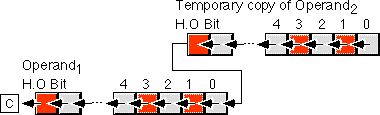
The shld instruction shifts bits in operand1 to the left. The H.O. bit shifts into the carry flag and the H.O. bit of operand2 shifts into the L.O. bit of operand1. Note that this instruction does not modify the value of operand2, it uses a temporary copy of operand2 during the shift. The immediate operand specifies the number of bits to shift. If the count is n, then shld shifts bit n-1 into the carry flag. It also shifts the H.O. n bits of operand2 into the L.O. n bits of operand1. Pictorially, the shld instruction is:
The shld instruction sets the flag bits as follows:
The shld instruction is useful for packing data from many different sources. For example, suppose you want to create a word by merging the H.O. nibbles of four other words. You could do this with the following code:
                mov     ax, Value4      ;Get H.O. nibble
                shld    bx, ax, 4       ;Copy H.O. bits of AX to BX.
                mov     ax, Value3      ;Get nibble #2.
                shld    bx, ax, 4       ;Merge into bx.
                mov     ax, Value2      ;Get nibble #1.
                shld    bx, ax, 4       ;Merge into bx.
                mov     ax, Value1      ;Get L.O. nibble
                shld    bx, ax, 4       ;BX now contains all four nibbles.
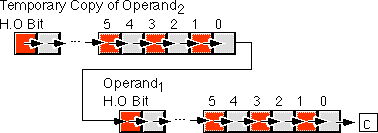
The shrd instruction is similar to shld except, of course, it shifts its bits right rather than left. To get a clear picture of the shrd instruction, consider:
The shrd instruction sets the flag bits as follows:
shrd instruction doesn't affect any flags.
Quite frankly, these two instructions would probably be slightly more useful if Operand2 could be a memory location. Intel designed these instructions to allow fast multiprecision (64 bits, or more) shifts.
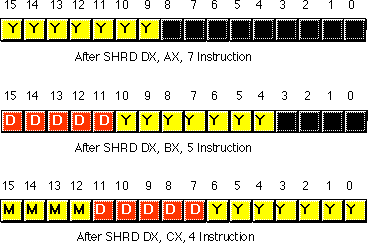
The shrd instruction is marginally more useful than shld for packing data. For example, suppose that ax contains a value in the range 0..99 representing a year (1900..1999), bx contains a value in the range 1..31 representing a day, and cx contains a value in the range 1..12 representing a month (see Chapter One). You can easily use the shrd instruction to pack this data into dx as follows:
                shrd    dx, ax, 7
                shrd    dx, bx, 5
                shrd    dx, cx, 4
The rotate instructions shift the bits around, just like the shift instructions, except the bits shifted out of the operand by the rotate instructions recirculate through the operand. They include rcl (rotate through carry left), rcr (rotate through carry right), rol (rotate left), and ror (rotate right). These instructions all take the forms:
        rcl     dest, count
        rol     dest, count
        rcr     dest, count
        ror     dest, count
The specific forms are
        rcl     reg, 1
        rcl     mem, 1
        rcl     reg, imm        (2)
        rcl     mem, imm        (2)
        rcl     reg, cl
        rcl     mem, cl

        rol uses the same formats as rcl.
        rcr uses the same formats as rcl.
        ror uses the same formats as rcl.

2- This form is avialable on 80286 and later processors only.
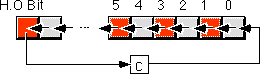
The rcl (rotate through carry left), as its name implies, rotates bits to the left, through the carry flag, and back into bit zero on the right:
Note that if you rotate through carry an object n+1 times, where n is the number of bits in the object, you wind up with your original value. Keep in mind, however, that some flags may contain different values after n+1 rcl operations.
The rcl instruction sets the flag bits as follows:
rcl sets the overflow flag if the sign changes as a result of the rotate. If the count is not one, the overflow flag is undefined.
rcl instruction does not modify the zero, sign, parity, or auxiliary carry flags.
Important warning: unlike the shift instructions, the rotate instructions do not affect the sign, zero, parity, or auxiliary carry flags. This lack of orthogonality can cause you lots of grief if you forget it and attempt to test these flags after an rcl operation. If you need to test one of these flags after an rcl operation, test the carry and overflow flags first (if necessary) then compare the result to zero to set the other flags.
The rcr (rotate through carry right) instruction is the complement to the rcl instruction. It shifts its bits right through the carry flag and back into the H.O. bit:
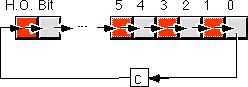
This instruction sets the flags in a manner analogous to rcl:
rcr sets the overflow flag if the sign changes (meaning the values of the H.O. bit and carry flag were not the same before the execution of the instruction). However, if the count is not one, the value of the overflow flag is undefined.
rcr instruction does not affect the zero, sign, parity, or auxiliary carry flags.
Keep in mind the warning given for rcl above.
The rol instruction is similar to the rcl instruction in that it rotates its operand to the left the specified number of bits. The major difference is that rol shifts its operand's H.O. bit, rather than the carry, into bit zero. Rol also copies the output of the H.O. bit into the carry flag:
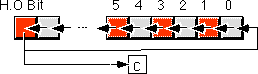
The rol instruction sets the flags identically to rcl. Other than the source of the value shifted into bit zero, this instruction behaves exactly like the rcl instruction. Don't forget the warning about the flags!
Like shl, the rol instruction is often useful for packing and unpacking data. For example, suppose you want to extract bits 10..14 in ax and leave these bits in bits 0..4. The following code sequences will both accomplish this:
                shr     ax, 10
                and     ax, 1Fh

                rol     ax, 6
                and     ax, 1Fh
The ror instruction relates to the rcr instruction in much the same way that the rol instruction relates to rcl. That is, it is almost the same operation other than the source of the input bit to the operand. Rather than shifting the previous carry flag into the H.O. bit of the destination operation, ror shifts bit zero into the H.O. bit:
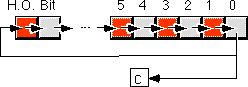
The ror instruction sets the flags identically to rcr. Other than the source of the bit shifted into the H.O. bit, this instruction behaves exactly like the rcr instruction. Don't forget the warning about the flags!